



 Download Free (.pdf)

Commercial energy storage developers are increasingly required to evaluate opportunities with limited information. They must also distinguish realistic projections from overly optimistic assumptions and ensure assets keep delivering value long after commissioning. The challenge is that critical decisions rarely happen under ideal circumstances. Utility data may be incomplete, project proposals may produce conflicting results, and operating assets can deviate from expected performance over time.
Our ETB Consulting team recently hosted the webinar, Unlock Hidden Value in Solar and Storage Sites: Practical Analytics for Smarter Development and Operations. It explored how analytics can help developers uncover opportunities, reduce uncertainty, and improve project outcomes throughout the asset lifecycle. Let’s look at three real-world examples that highlight the challenges that developers face and demonstrate how disciplined analysis can support better decision-making.
Example 1: Portfolio Screening & Prioritization
The Challenge
Many developers are managing large portfolios of prospective solar and storage sites while facing tax credit deadlines, development milestones, and financing pressures. At the same time, utility data is often incomplete, load information may be missing, and facility load profiles can vary significantly across a portfolio.
These conditions create a difficult balancing act: developers need to move quickly without sacrificing analytical rigor. Waiting for perfect information can slow development and cause valuable opportunities to be missed, but making decisions with insufficient analysis also introduces risk.
Recommended Approach
A more effective approach is to treat project evaluation as a phased process. Early-stage assessments can use reasonable assumptions, benchmarking data, and preliminary utility information to identify promising sites and narrow the portfolio. The goal is not to produce a perfectly accurate financial model on day one. Instead, it’s to determine which opportunities deserve additional investment of time and resources.
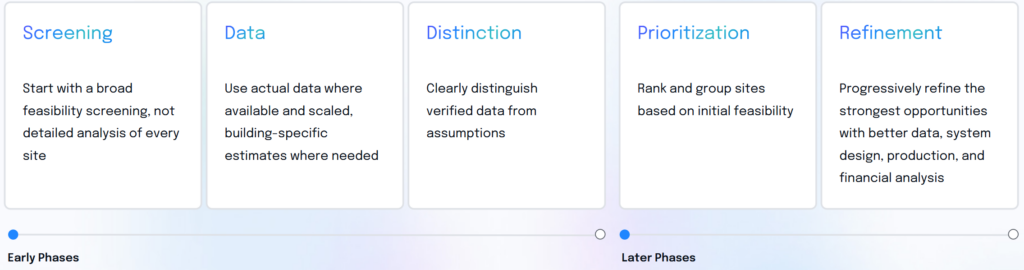
As projects advance and more information becomes available, assumptions can be refined, and models can become increasingly accurate. This phased approach ensures that imperfect data doesn’t stop progress, and it allows developers to focus their time and budget on the highest-potential sites.
Example 2: Standardizing & Evaluating Competing Proposals
The Challenge
Competing proposals can often generate dramatically different savings forecasts despite relying on the same underlying utility data. It’s not uncommon for multiple developers to analyze the same project and arrive at very different conclusions. System sizing, projected savings, payback periods, and financial returns can vary significantly, even when the underlying utility data is identical.
These discrepancies often stem from differences in tariff interpretation, battery dispatch assumptions, degradation forecasts, financing structures, and incentive modeling. As a result, the proposal with the highest projected savings may not necessarily represent the most realistic outcome.
Recommended Approach
The goal is to establish a repeatable evaluation process that standardizes the data, establishes baseline assumptions, and allows for comparisons across normalized proposals.
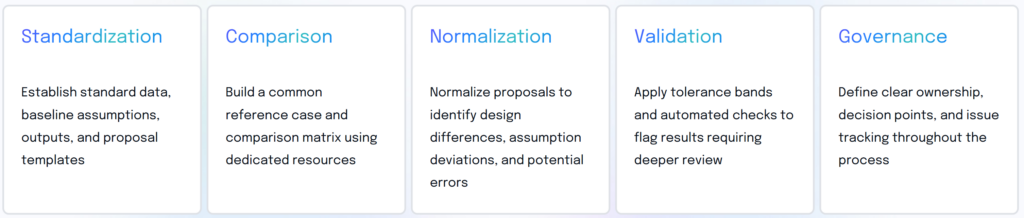
A repeatable evaluation process helps developers spend less time reconciling inconsistent analyses. They can focus on the proposals with the strongest combination of performance, credibility, and risk management.
Example 3: Protecting Asset Performance & Value
The Challenge
Many organizations assume a project is performing as expected simply because it’s online. But an operational asset isn’t necessarily an optimized asset. When an energy bill increases or expected savings decrease, it’s easy to assume the storage system is underperforming. However, that isn’t always the case. Utility tariffs may change, facility energy consumption may shift, equipment may degrade, or dispatch strategies may no longer align with actual operating conditions. Without ongoing monitoring, these issues can remain unnoticed for extended periods, gradually reducing project value.
Recommended Approach
Understanding the true source of performance gaps and preserving value begins with establishing visibility into the asset’s operational performance and savings.
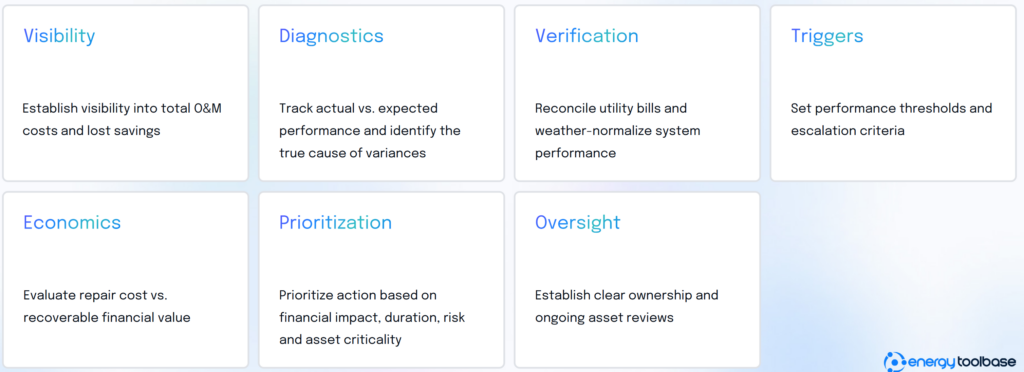
That’s why ETB Monitor is such an important tool for keeping your system and savings intact. It provides real-time insight into your battery’s dispatch performance, state of charge, energy consumption, utility bill savings, and more. Developers who maintain visibility into post-installation performance with tools like ETB Monitor are often better positioned to maximize long-term project benefits. They can also address problems rapidly when they arise.
Better Decisions Through Better Analytics
Each of these three examples reinforces the same principle: data-driven decision-making is one of the most valuable competitive advantages available to energy storage developers.
Whether you’re prioritizing sites within a large portfolio, evaluating competing proposals, or optimizing operating assets, the same approach applies. Success depends on understanding assumptions, validating outcomes, and making data-driven decisions. Developers that embrace this analytical discipline are better positioned to reduce risk, improve project economics, and create long-term value for their customers.
Interested in learning how advanced analytics can support your development and operations strategy? Get in touch with our ETB Consulting team to explore how their professional services can help optimize your solar and energy storage projects.