 Download Free (.pdf)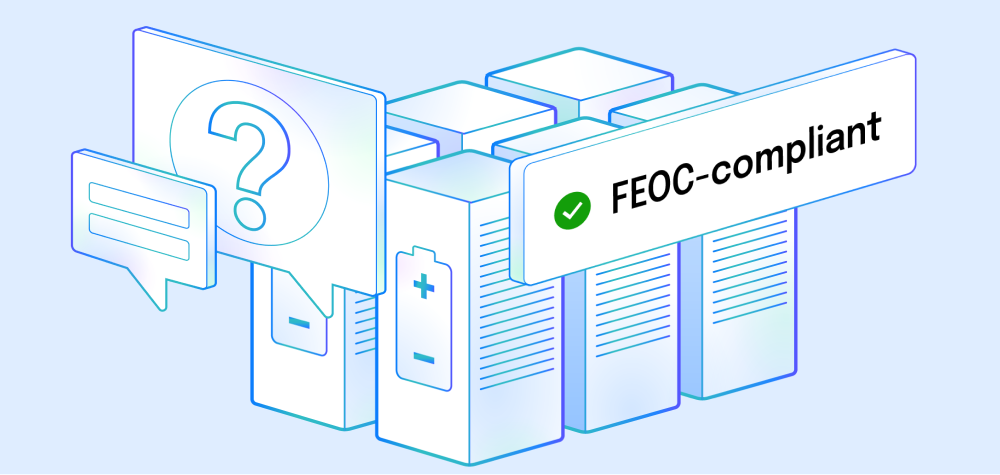

Solar and energy storage developers have questions regarding Foreign Entity of Concern (FEOC) and Prohibited Foreign Entity (PFE) rules and restrictions, which is why our recent “Navigating Prohibited Foreign Entity Compliance for Energy Storage Projects in 2026-2027” webinar went into detail to explain the many complexities of these evolving rules and answer as many questions as possible.
Our goal at Energy Toolbase is not just to offer you high-quality software: we also want to provide you with the knowledge and information you need to make your projects successful. Here are some of the most asked questions we’ve received about FEOC and PFE Compliance for your projects:
What is the difference between PFE and FEOC?
- A Foreign Entity of Concern is the broader policy framework that generally covers entities connected to countries such as China, Russia, Iran, and North Korea. A Prohibited Foreign Entity is a specific entity that’s restricted from claiming the tech-neutral tax credits of Sections 45Y and 48E. Furthermore, there are two categories of PFEs: Specified Foreign Entity and Foreign-Influence Entity.
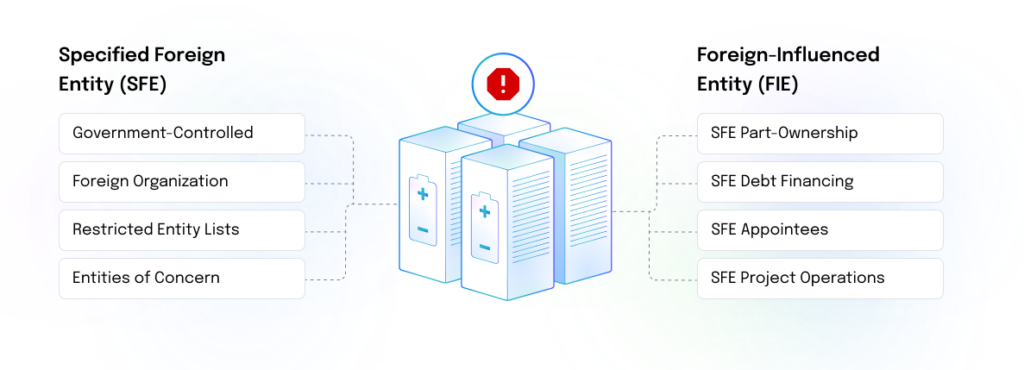
For storage developers, the main takeaway is that tax credit eligibility may depend not only on who owns a company, but also on whether a project receives excessive Material Assistance from a PFE.
When do PFE restrictions take effect for energy storage projects?
- PFE restrictions generally apply to projects claiming the technology-neutral clean energy tax credits under Sections 45Y and 48E that begin construction after December 31, 2025. The Treasury Department and IRS issued interim guidance through Notice 2026-15 to help taxpayers evaluate compliance until more comprehensive regulations are finalized.
- Because compliance thresholds phase in over time, developers should evaluate sourcing decisions early in the procurement process rather than waiting until later, during financing or tax credit monetization stages.
Which battery manufacturers currently offer PFE-compliant products?
- Currently, there is no IRS-certified master list of FEOC-compliant batteries. Compliance is dependent on the specific product, supply chain, manufacturer, applicable tax year, project, construction date, and calculation method.
- Developers should request supplier certifications, supply chain documentation, and written representations regarding PFE compliance. A battery offering that is compliant for one project may not necessarily satisfy compliance requirements for every project scenario. You can contact Energy Toolbase directly to discuss what FEOC-compliant batteries are available for your projects.
How does PFE compliance affect project timelines and equipment availability?
- PFE compliance adds another layer of due diligence to project procurement. Developers must evaluate suppliers, collect documentation, review ownership structures, and assess component sourcing before equipment is purchased. Energy Toolbase supports this entire process and ensures compliance is met.
What documentation can manufacturers provide for our clients that speaks to the origin of materials?
- Ideally, you’d want an entire PFE Compliance Package, which includes corporate documentation, manufacturing documents, as well as supply-chain and compliance documentation. Energy Toolbase helps ensure you have the correct documents to provide for your customers.
What should customers be asking developers on the front end to vet FEOC compliance and avoid post-execution delays?
- There are many questions to avoid project issues. Simply asking “Is this battery FEOC-compliant?” is too broad. Many questions surround ownership, supply chain, and documentation. These discussions are best held before equipment procurement begins. Identifying compliance concerns after contracts are executed can create delays, redesigns, or other equipment challenges. Energy Toolbase can walk you through equipment selection to ensure compliance and avoid costly delays.
Can a project qualify for Domestic Content but fail PFE compliance?
- Yes.
- Domestic Content and PFE compliance are separate requirements. A project could potentially satisfy Domestic Content thresholds while still exceeding allowable levels of Material Assistance from a PFE. Conversely, a project could satisfy PFE requirements without qualifying for the Domestic Content bonus credit. Developers should therefore run separate analyses for Domestic Content and PFE compliance rather than assuming one automatically satisfies the other.
What is the PFE safe harbor and how does it simplify compliance?
- The PFE safe harbor is an IRS-approved methodology that allows developers to use standardized cost percentages and supplier certifications to evaluate compliance rather than conducting a detailed, component-by-component cost analysis for every project. The goal is to provide a practical pathway for determining whether a project exceeds the allowable level of material assistance from a PFE.
- There are three types of safe harbors: Identification, Cost Percentage, and Certification. Identification and Cost Percentage Safe Harbors use predefined cost percentages from the 2023-2025 IRS tables for certain technologies instead of direct costs, while the Certification Safe Harbor relies on supplier certifications regarding component sourcing and manufacturing. These safe harbors can significantly reduce the burden associated with tracing every material and component in a battery supply chain.
How is the Material Assistance Cost Ratio (MACR) calculated using the safe harbor tables?
- Under the safe harbor approach, developers use IRS-provided cost allocation tables that assign percentages of a project’s total cost to specific manufactured products and components. Those percentages are then used along with supplier certifications to determine how much of a project’s value is attributable to non-PFE sources versus PFE sources.
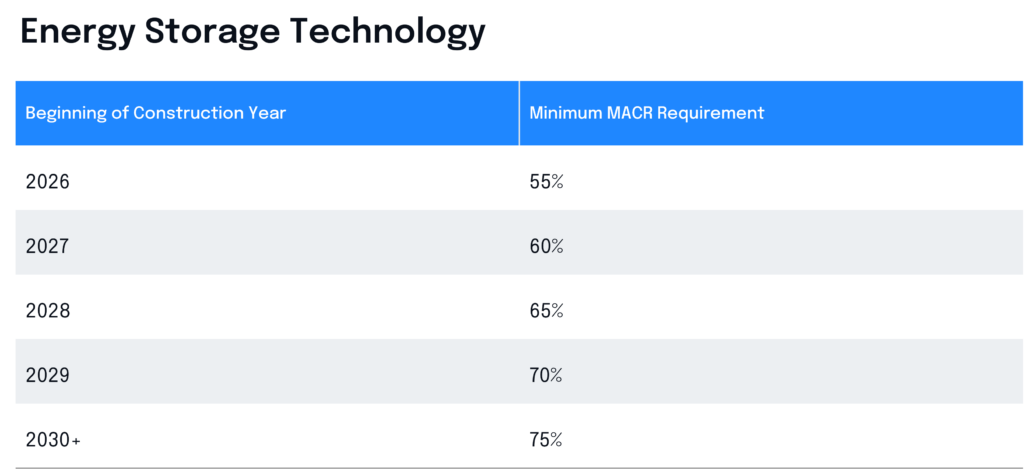
- For battery energy storage projects, the analysis focuses on major manufactured products and components within the system rather than attempting to trace every raw material. The resulting Material Assistance Cost Ratio is compared against the applicable threshold for the year construction begins.
What are the key details that need to be included in a self-attestation letter from a supplier that is claiming compliance?
- Under the Certification Safe Harbor, the certification needs to include the supplier’s EIN or comparable foreign identification number, be signed under penalties of perjury, and be retained by the supplier and taxpayer for at least six years.
What documentation is required when submitting for FEOC compliance?
- If the taxpayer uses an IRS safe harbor, Notice 2026-15 says the taxpayer must provide a statement identifying: the specific safe harbor used, applicable safe-harbor table, how the taxpayer applied the safe harbor, and those resulting calculations.
What happens if a project is found to be non-compliant after equipment has been ordered or installed?
- The consequences depend on the facts and timing, but the most significant risk is loss of eligibility for affected tax credits. If a project fails applicable PFE requirements, the project owner may be unable to claim associated federal incentives.
- This is why developers are increasingly emphasizing front-end diligence and supplier warranties. Discovering a compliance issue after procurement can result in costly equipment replacements, schedule delays, or financing complications.
These are just a few of the questions that energy storage developers may have at some point regarding FEOC and PFE rules. Further guidance from the Treasury and IRS that is coming soon will likely lead to even more questions. That’s why our Energy Toolbase experts are here to help. Get in touch with us today to see how we can answer your questions, help you with FEOC compliance, and deploy successful projects.