

 Download Free (.pdf)

Over the past year, the IRS has released additional guidance surrounding Sections 45Y and 48E tax credits, introducing new restrictions designed to limit foreign influence. These rules add a new layer of complexity to storage project development by examining ownership structures, financing arrangements, supplier relationships, and equipment sourcing. Failure to comply with Prohibited Foreign Entity (PFE), also known as Foreign Entity of Concern (FEOC), rules can result in the loss of the underlying federal tax credit altogether.
That’s why, for developers planning battery energy storage projects, understanding PFE compliance is now critical for project success.
What Is a Prohibited Foreign Entity?
A PFE is an entity that’s restricted from claiming the tech-neutral tax credits of 45Y and 48E because of its connections to certain foreign governments, organizations, ownership structures, or influence arrangements.
Under current legislation, a PFE generally falls into one of two categories:
- Specified Foreign Entity (SFE)
- Foreign-Influenced Entity (FIE)
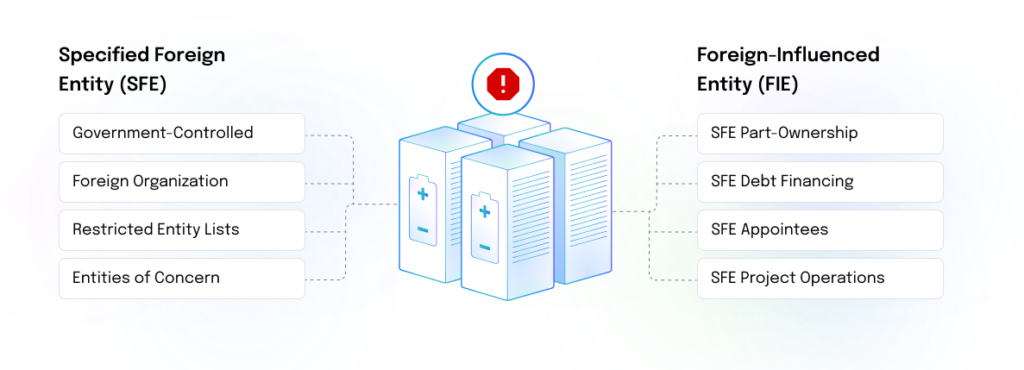
Specified Foreign Entity (SFE)
An SFE includes certain foreign organizations associated with governments or organizations identified by the U.S. government as entities of concern.
The law specifically identifies covered nations that include:
- China
- Russia
- Iran
- North Korea
In some cases, entities incorporated in these countries or organizations appearing on certain federal restricted lists may qualify as an SFE.
Foreign-Influenced Entity (FIE)
An FIE is an entity that may be U.S.-based but is subject to significant foreign influence or control. This includes situations where an SFE:
- Owns 25% or more of an entity
- Multiple SFEs collectively own 40% or more
- Provides 15% or more of the company’s debt financing
- Can appoint executives, board members, or other key decision-makers
- Exercises effective control over project operations
There are some exceptions to what is considered a PFE, including publicly traded companies. Further guidance from Treasury and IRS regarding PFE identification is still under development; however, in the meantime, organizations that establish robust compliance processes now will likely be better positioned to adapt when additional guidance arrives.
PFE Compliance vs. Domestic Content
A common misconception in the market is that PFE compliance and domestic content compliance are essentially the same thing; however, they’re very different.
- PFE Compliance
PFE compliance serves as a gatekeeper for the tax credit itself and is focused on ownership, control, and financing. A project can satisfy domestic content requirements and still fail PFE compliance. Likewise, a project can satisfy PFE requirements without qualifying for the domestic content bonus.
- Domestic Content
Domestic content requirements are designed to encourage U.S.-based manufacturing, with a focus on qualifying steel, iron, and manufactured products. Meeting domestic content standards can increase project value through bonus tax credits. If a project fails to meet domestic content requirements, the developer may lose access to the bonus credit but can generally still claim the underlying tax credit.
Even if a project owner passes the entity-level test, the project can still be disqualified if PFEs contribute too heavily to the manufactured products incorporated into the project.
This is where the Material Assistance requirements come into play.
Understanding Material Assistance
Closely tied to the PFE rules are the Material Assistance restrictions. Rather than focusing on project ownership, Material Assistance evaluates the equipment and components that make up the energy storage system itself.
For battery energy storage systems, developers must calculate a Material Assistance Cost Ratio (MACR), which measures the percentage of manufactured product costs that are not associated with prohibited foreign entities.
The calculation generally:
- Identifies all manufactured products within the project.
- Determines the manufacturers of those products.
- Evaluates whether those manufacturers qualify as PFEs.
- Calculates a compliance percentage against annual statutory thresholds.
The MACR must be no less than a certain percentage that varies by year and facility type.
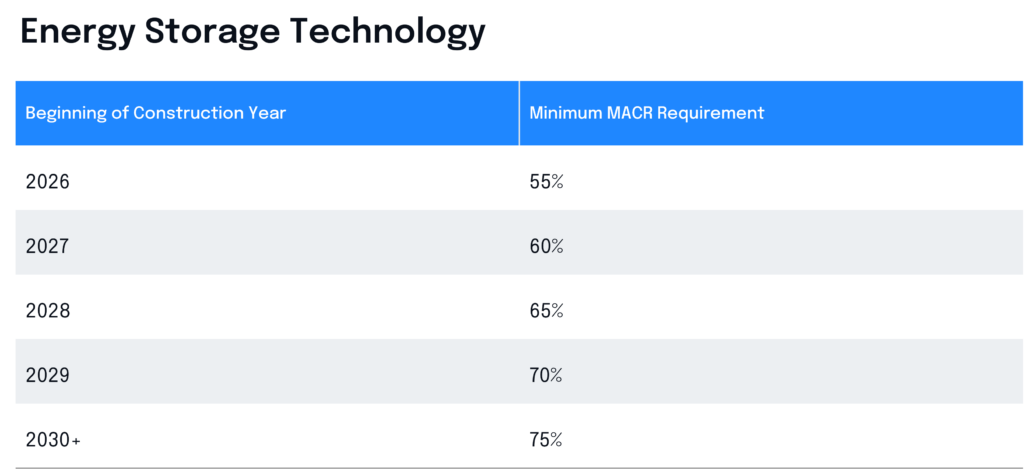
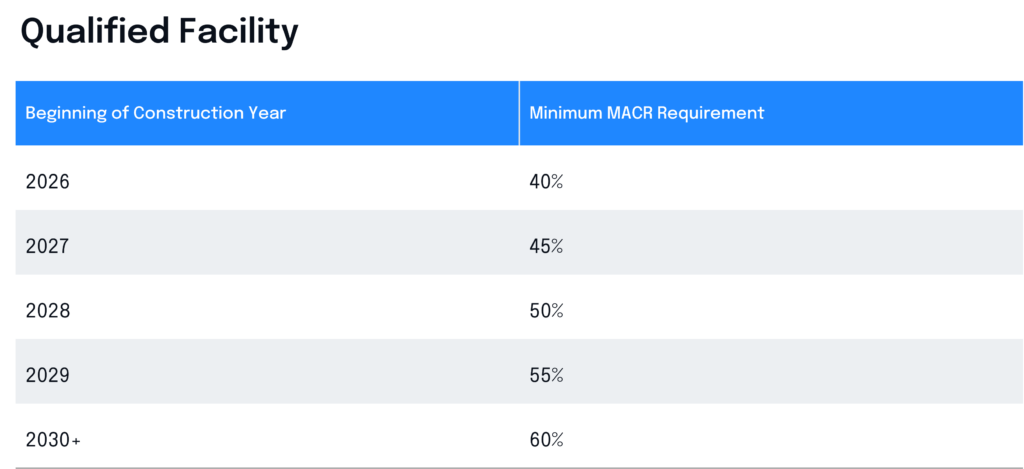
Unlike domestic content requirements, failure to satisfy MACR requirements can jeopardize the entire tax credit.
The Importance of IRS Safe Harbors
To simplify compliance calculations, the IRS has introduced interim safe harbors that provide greater certainty when evaluating compliance. The IRS currently offers three primary safe harbor approaches:
- Identification Safe Harbor
This safe harbor helps developers determine how system components should be classified and evaluated. You can use the 2023-2025 Safe Harbor Tables found in Notice 2023-38 and Notice 2025-08 to identify listed products or components.
- Cost Percentage Safe Harbor
This approach provides predefined cost percentages from IRS tables for certain technologies instead of actual direct costs.
- Certification Safe Harbor
Arguably the most practical option for many developers, the certification safe harbor allows taxpayers to rely on supplier certifications regarding component sourcing and manufacturing.
When properly documented, these certifications can provide a meaningful level of confidence and reduce compliance uncertainty.
Why Supplier Documentation Is Critical
As tax credit transfer markets mature and PFE compliance guidance develops, documentation quality is becoming increasingly important. Developers should expect to gather manufacturer certifications, material bills, cost breakdowns, ownership information, and supplier records. Having this detailed documentation will make the compliance process much easier.
And it’s important to remember that the best time to address PFE compliance is before procurement decisions are finalized. The most successful developers will increasingly integrate tax compliance reviews directly into supply chain and procurement workflows, which will better position them to manage risk and preserve tax credit eligibility.
How Energy Toolbase Helps Developers Evaluate PFE Compliance
Storage developers need tools that can simplify their projects as much as possible: that’s where Energy Toolbase can help.
Energy Toolbase is more than just a software company—we want to help you and your clients understand where the market is moving, what opportunities are available, and how we can get you there. You can make any project look great based on overly optimistic assumptions, but our goal is to help make your projects real based on accurate analyses, modeling, and optimization.
ETB Developer enables you to accurately model nearly every aspect of a solar and energy storage project so you can see what value streams are available and how to tap into them. We also have FEOC-compliant ESS options available for selection to make modeling and maintaining compliance easy. By working directly with FEOC-compliant hardware vendors, we can help you secure compliant systems that match your project needs
After modeling, ETB Controller with Acumen AI® directly controls your storage assets to maximize the economic benefits of your system by prioritizing the most advantageous applications like demand charge management or energy arbitrage at any given time. And lastly, ETB Monitor provides comprehensive insight into system performance, project economics and savings, and compliance tracking.
By combining storage modeling, dispatch optimization, and project financial analysis into a single platform, developers can make more informed procurement decisions while adapting to evolving PFE compliance requirements.
PFE regulations represent a fundamental shift in how developers evaluate suppliers, financing structures, and project partners. Success under Section 48E will require more than simply sourcing eligible equipment. It will require thoughtful procurement planning, supplier transparency, strong documentation practices, and a clear understanding of how ownership and control structures affect project eligibility.
Our Energy Toolbase team is here to help you navigate these complexities. You can watch our “Navigating Prohibited Foreign Entity Compliance for Energy Storage Projects in 2026-2027” webinar conducted with the Washington National Tax team that goes into greater detail about PFE compliance, and you can also get in touch with our team to see how we can help you successfully deploy your projects today.