 Download Free (.pdf)
Designing battery systems is far from straightforward, and without the right renewable energy storage software to manage that complexity, problems such as inaccurate simulations and imprecise modeling can affect reliability and long-term energy costs.
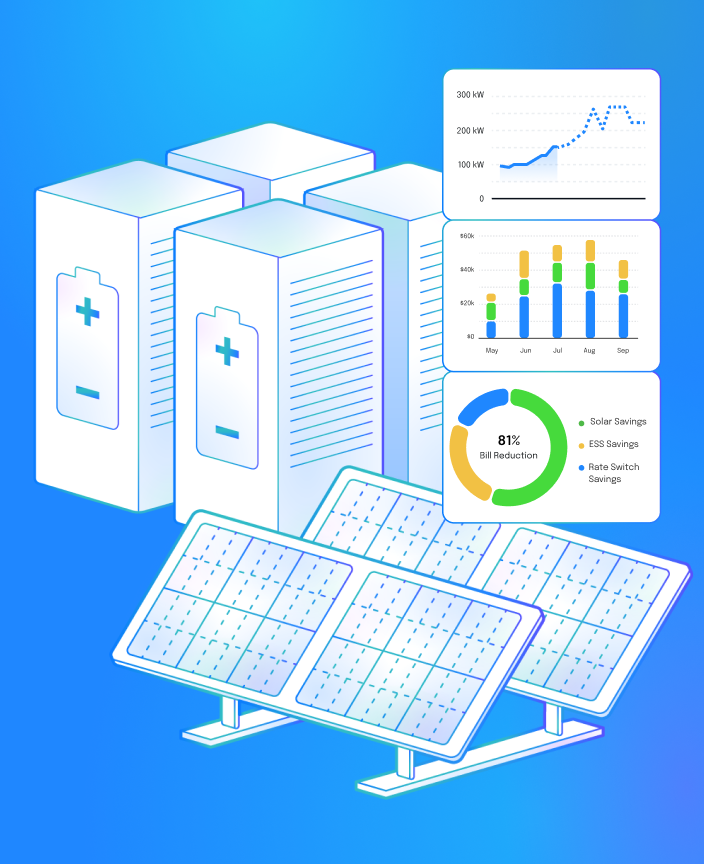
Outdated software (or systems reliant on manual monitoring and interventions) lack the energy storage data visualization tools developers need to track solar power production, utility tariffs, electricity demand, and battery performance. This means vital performance optimization opportunities are lost.
The Energy Toolbase team has shared insights into the most frequent issues we encounter and summarized how advanced energy storage software for solar power systems, such as our ETB Developer, resolves them.
Challenge 1: The Inability to Model Complex Energy Systems
Energy storage systems have multiple moving parts and variables that change constantly throughout the day, from solar generation to demand for electricity, and, of course, energy prices.
It’s very difficult, if not impossible, to predict how those variables will interact or adjust, and at what point, either manually or without suitable software, especially for sites with older systems that collate data and report hourly or daily, and not within fifteen-minute cycles. Inaccurate or delayed reporting means operators are reacting retrospectively, and often when it is too late to make an impact, or dependent on static discharge and charging cycles that are left to function even long after they have become inefficient.
Challenge 2: No Resources to Simulate Battery Behavior
Simulations are used throughout energy storage projects, and to be accurate, they need models that help to predict how systems will perform and the financial returns they will deliver. Either a lack of battery simulations or inaccurate modeling can have significant impacts, because batteries don’t store energy statically, but operate strategically to:
- Charge when solar energy production peaks
- Discharge when electricity prices are highest
- Lower energy costs through demand charge reduction
Developers may be left making assumptions about real-world battery behavior, often leading to inaccurate projections and unexpected operational costs in the future.
Challenge 3: Software That Cannot Interpret Large Volumes of Data
The datasets used in energy storage software are enormous, but essential, and cover a wide scope, from tariff structures to load demand trends and battery charging cycles. Not having on-demand access to that data, mapped and visualized in easy-to-interpret charts, is a problem.
Data in this volume cannot be processed or analyzed manually, and trying to spot patterns or changes isn’t something any operator or developer can reliably perform with out-of-date energy storage software. Outcomes mean that sites may not truly understand their system performance or fall back on outdated strategies, resulting in unnecessarily high costs.
Challenge 4: Inaccurate Financial Modeling
While energy storage projects rely on technical performance and automated adjustments, they ultimately need to be financially viable. At the planning stage, software is a crucial tool that developers use to present recommendations to investors and stakeholders and to demonstrate the available returns.
Precise modeling incorporates analyses of factors like:
- Predicted electricity savings
- Demand charge reduction
- Payback periods for investors
- Energy pricing at the time of use
Without this depth of insight, financial models are at best uncertain and rely on assumptions or guesses that may prove false, undermining the feasibility of a project altogether.
How to Resolve Energy Storage Software Challenges
If any of the issues mentioned here are familiar, our advice is to consider an advanced energy storage software platform like ETB Developer, which has been engineered to address each of them.
With integrated modeling, visualization tools, and financial analytics built into a single product, users can simulate solar and storage systems of all sizes and ensure they make informed decisions about optimal system configurations from the project development phase onward.