 Download Free (.pdf)

*Updated on June 5, 2026
Calculating the avoided cost of a solar project means determining how much money a customer is expected to save by generating their own electricity instead of purchasing it from the utility. While many people focus on the amount of energy a solar system produces, the actual financial value of that energy depends on factors such as utility rate structures, energy consumption patterns, net billing and avoided cost rates, and the design of the solar system itself.
Understanding avoided cost is essential when evaluating the costs of a solar project and its long-term financial performance. Accurate avoided cost calculations help developers create realistic savings estimates, properly size systems, and provide customers with transparent projections. In contrast, oversimplified calculations can lead to unrealistic expectations and inaccurate financial analyses.
What Is ‘Avoided Cost?’
‘Avoided cost’ refers to the utility expenses that a customer no longer incurs because a solar energy system is generating electricity on-site. In simple terms, it represents the value of the utility energy that the customer avoids purchasing.
However, avoided cost is not always equal to a customer’s average electricity rate. Utility bills often contain a combination of energy charges, demand charges, fixed fees, riders, and other costs. As a result, the value of each kilowatt-hour generated by a solar system can vary significantly depending on when and how that energy is used.
Factors That Influence Solar Project Savings
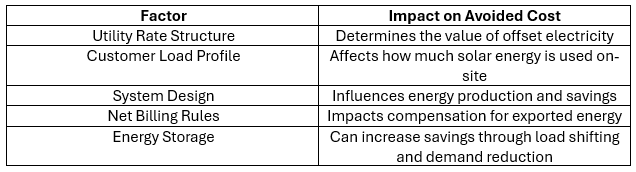
Several variables affect the avoided cost of a solar project, including:
Utility Rate Structures
Utility tariffs play a major role in determining project savings. Time-of-use rates, demand charges, tiered pricing structures, and rate switches can all impact the value of solar generation. Understanding the customer’s specific tariff is critical for accurate financial modeling.
Customer Load Profiles
Every facility consumes energy differently. A customer’s load profile determines how closely solar production aligns with on-site energy consumption. Projects that offset electricity during high-cost periods often produce greater savings than projects serving loads during lower-cost periods.
Solar System Design
System size, orientation, production estimates, and operational assumptions all influence avoided cost calculations. Oversizing or undersizing a system can affect both energy savings and overall project economics.
Net Billing and Avoided Cost Rates
As utilities continue transitioning away from traditional net metering programs, net billing and avoided cost rates are becoming increasingly important. These programs determine how exported solar energy is compensated and can significantly impact project savings projections. Accurately modeling export compensation is essential for understanding the true financial value of a solar project.
Why Accurate Modeling Matters
Accurate avoided cost calculations help developers provide realistic savings estimates and improve project confidence. They also support better decision-making around system sizing, financing, and energy storage integration.
Modern software tools can evaluate multiple variables simultaneously, including utility rates, load profiles, and solar production forecasts. This allows developers to identify optimization opportunities and better understand how different assumptions affect project outcomes.
Optimizing the Avoided Cost of a Solar Project
The most successful solar projects are not necessarily those that generate the most electricity; they are the ones that maximize financial value. Optimizing avoided cost requires a detailed analysis of utility rates, customer usage patterns, and system design characteristics.
By accurately modeling these factors, developers can create more transparent proposals, improve customer confidence, and ensure that projected savings reflect real-world operating conditions. As the solar industry continues to evolve, precise avoided cost analysis remains one of the most important components of successful project development.