 Download Free (.pdf)

IMPORTANT MONTHLY UPDATES & ANNOUNCEMENTS
We’re covering the new fixed charges from San Diego Gas & Electric (SDG&E) and other California updates, plus we look at new time-of-use (TOU) plans for Pennsylvania customers, highlight Anaheim Public Utilities and the growing trend of reducing export credit values, and share our quarterly update numbers.
Basic Service Charges for SDG&E Residential Customers
This month, SDG&E implemented the Basic Services Charges (BSC) for residential customers as part of its plan to restructure electricity pricing by reallocating some volumetric ($ per kilowatt-hour) energy costs to nonvolumetric fixed charges. The stated purpose of this fixed charge is to cover the costs of connecting customers to the grid and to help with maintaining grid infrastructure.
This change goes back to Assembly Bill 205 passed back in 2022. SDG&E is the first of the three investor-owned utilities (IOU) to restructure their residential rate schedules with the BSC, while Southern California Edison (SCE) and Pacific Gas & Electric (PG&E) are set to do the same in November 2025 and sometime in 2026, respectively.
The BSC is a fixed charge that is billed per day, resulting in an average monthly cost of $24.15. Discounts for qualified low-income customers in CARE and FERA programs do exist:
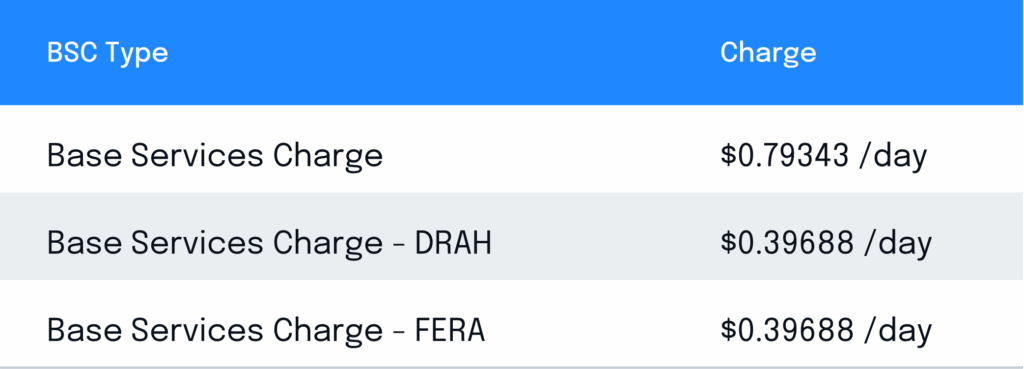
Low energy users may see a small increase in their bill due to more of their costs coming from nonvolumetric charges, while medium and high energy users may see a slight decrease due to a lower cost per kilowatt-hour.
California IOU Rate Updates
The three IOUs also updated their rates this past September and October. In total, our Utility Rates Team updated 250 rate schedules in ETB Developer for the California IOUs following these updates. (That number doesn’t include the many Community Choice Aggregates that we’ve updated as well!) This includes updates to system average bundled rates (SAR) as well as the implementation of the BSC to residential schedules for SDG&E customers. Here are the quick facts about the impact of these updates for each IOU:
PG&E:
The September update resulted in a 2.1% decrease to system average bundled rates (SAR) and a 3.6% decrease to Direct Access (DA) and Community Choice Aggregation (CCA) customers.
These decreases follow several energy-related charges that were fully recovered and are no longer included.
SCE:
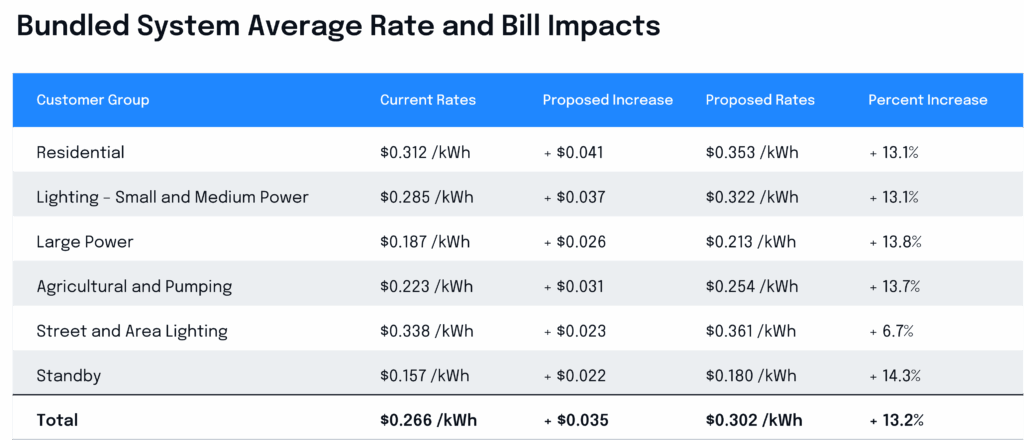
The California Public Utility Commission authorized changes to SCE’s revenue requirements. The impact is a decrease in delivery rates with increases in revenue from generation components, wildfire management, and general funding.
The overall result is a 13.2% increase to SAR.
SDG&E
Restructured residential rates by implementing the BSC, which is a fixed charge not subject to volumetric pricing.
Minor decrease of 0.3 cents/kWh or -1.5% to SDG&E’s system average delivery rates, resulting in a 0.3 cents/kWh or -0.9% decrease to SAR.
New Time-of-Use Plans for Pennsylvania IOUs
Earlier this year, we highlighted the significant rate increases customers would face—anywhere from 10% to 30% depending on customer class—from utilities in Pennsylvania like Met-Ed, West Penn, Penelec, and Penn Power. Now, in response to those rate hikes, these utilities are implementing TOU plans to give consumers the opportunity to shift their energy consumption to lower priced hours. This is a growing trend we’ve seen from utilities across the country as they’re prioritizing grid optimization and peak load management as population growth and demand outpaces the construction and optimization of existing infrastructure to provide the required generation and capacity. This is most prevalent in states located within PJM’s territory like Pennsylvania with increasing numbers of data centers that strain the grid and require large amounts of power.
The addition of these TOU periods gives customers the chance to reduce their costs by shifting their energy usage to lower priced periods like Off-Peak or Super Off-Peak:
On-Peak: 2 p.m. – 9 p.m. Monday through Friday
Super Off-Peak: 11 p.m. – 6 a.m. Every Day
Off- Peak: All other hours
Customers will pay less for energy consumed during the Off-Peak and Super Off-Peak hours; however, they’ll pay more for energy consumed during On-Peak hours than they would on a non-TOU rate plan.
Existing NEM customers are eligible for these TOU plans. Opting into the TOU rider can also improve the economics of energy storage since you can charge the battery during lower priced periods and use that energy during the On-Peak hours when prices are higher. The best way to do this is with an energy management system, like ETB Controller with Acumen AI™, designed to maximize results by precisely charging and discharging at the most opportune times. ETB Controller uses our Acumen AI technology to autonomously prioritize the greatest value stream for your energy assets at any given time, whether that’s TOU arbitrage, demand charge management, or one of its many other applications. If you’re looking for solutions to take advantage of TOU pricing and reduce costs, then reach out to us for an energy storage consultation today.
Anaheim Public Utilities Export Credit Reduction
Another reason to consider storage is the reduction in value of export energy credits from utilities like Anaheim Public Utilities in California. Anaheim Public Utilities reduced its solar export credit rate by approximately 33% between 2024 and 2025, as part of its ongoing transition away from retail-rate Net Energy Metering (NEM) to wholesale-based compensation under its NEM 2.0 program. This shift aligns more closely with California’s broader transition towards net billing under NEM 3.0, where export compensation is based on the value to the grid, not the retail price. This change generally results in lower payouts for customers who send excess solar energy back to the grid.
This trend is not limited to California: Several states across the country like Arizona, Idaho, and Illinois are moving away from retail compensation towards avoided cost-based models. As the value of exports under certain NEM frameworks is reduced, it begins to make more sense to store that energy and use it later, especially during peak hours when energy rates are higher.
That’s why accurate modeling software like ETB Developer is so important when planning your projects so you can find the best solar and energy storage set up for a particular project. You can take advantage of our NEM Programs feature that precisely models NEM and Net Billing tariffs, combined with accurate rate switching options, detailed solar and energy storage modeling, and powerful third-party integrations. When you combine your ETB Developer models with ETB Controller to maximize their value and ETB Monitor to receive real-time performance insights, you can be sure that you have the tools to stay ahead of the ever-changing renewable landscape.
Quarterly Numbers:
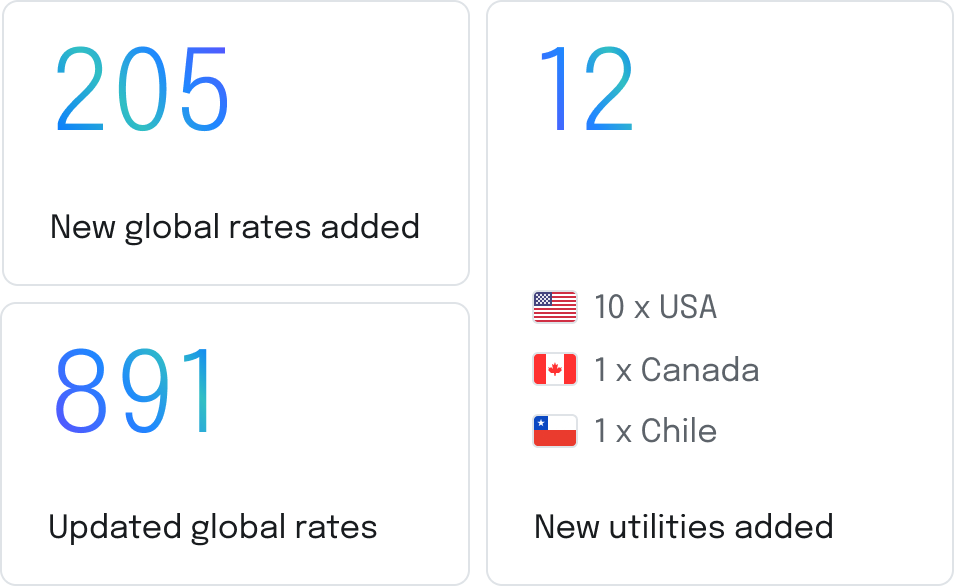
Our utility rates team enjoys sharing our progress with ETB users because much of it comes from user requests. Every utility and rate we add signifies expanding opportunities for solar and storage, and we think that is pretty neat! We quantify our Q3 successes below: