 Download Free (.pdf)

As we start a new year at Energy Toolbase, we’re reflecting on all things rate-related during the last 12 months that have impacted the solar and energy storage industry. From our rate database update numbers to the most impactful stories and trends. Join us as we recap 2025 and take a look at what’s coming in 2026.
Energy Toolbase by the Numbers
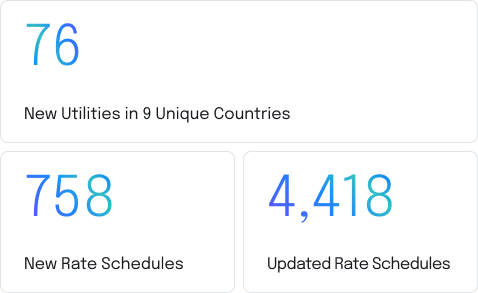
2025 was a very productive year for our internal rates database team. Our in-house team added 76 new utilities in 9 unique countries. We also added 758 new rate schedules and updated 4,418 existing rate schedules.
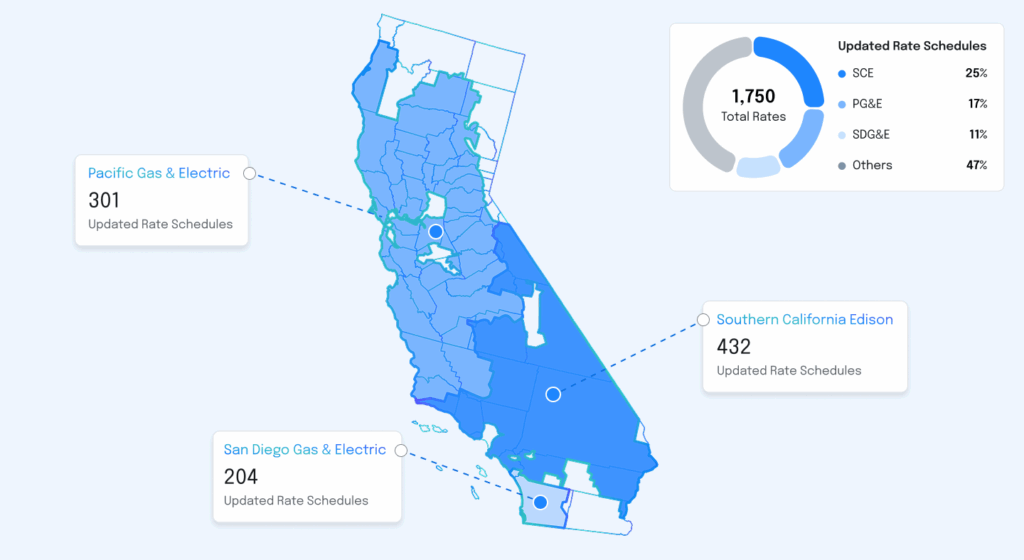
In the state of California alone, we updated a total of 1,750 rate schedules, the majority of which were from the Investor-Owned Utilities. Pacific Gas & Electric (PG&E) updated their rate schedules 3 times this year (January, March, and September) for a total of 301 updated PG&E rate schedules. Southern California Edison (SCE) experienced 4 rate updates (January, March, June, and October) for a total of 432 updated SCE rate schedules. Lastly, San Diego Gas & Electric (SDG&E) updated their rates 3 times (February, June, and October) for a total of 204 updated SDG&E rate schedules.
To help us achieve these numbers, we also added several new members to our in-house utility rates team. The work and precision of our rates team serve as the backbone of accurate project modeling, and we’re proud to have such a dedicated team.
New ETB Developer Features
We launched several new features this year for ETB Developer including enhancements to modeling and unlocking more ways to capture value from PV and energy storage systems.
ConnectedSolutions and Clean Peak Standard
We have a growing catalogue of demand response and grid services programs that we offer in ETB Developer, and earlier this year we added two more programs to that list: ConnectedSolutions and Clean Peak Standard.
These programs are available for customers in the Northeast and are designed to incentivize and compensate customers with ESS who reduce their load during designated peak hours. ConnectedSolutions is available for customers located in Massachusetts and Rhode Island and provides incentive rates of $200/kW and $275/kW for reduced demand for customers in Massachusetts and Rhode Island respectively. The Clean Peak Standard program is credit-based, and customers can generate and sell these credits.
ETB Developer makes it incredibly easy to accurately model, enroll, and manage ConnectedSolutions and Clean Peak Standard projects. With ETB Developer, you can model incentives, optimize energy storage strategies, project generated revenues, and seamlessly enroll into these programs. You can also further enhance your projects with our ETB Controller with Acumen AI™ that automates battery dispatch during peak events to ensure maximum financial returns. ETB Developer users can easily model the expected revenue and utility bill savings from these programs. Try our ETB Developer 14-day free trial to start modeling and capturing more value for your projects today.
Proposal Summary Page and Document Templates
These features added increased functionality to proposal customization and provided greater insight into the project’s financials. The Proposal Summary page enables a side-by-side comparison of different project designs and their summary values, including project cost & incentives, solar and storage details, electric bill savings, and transaction information.
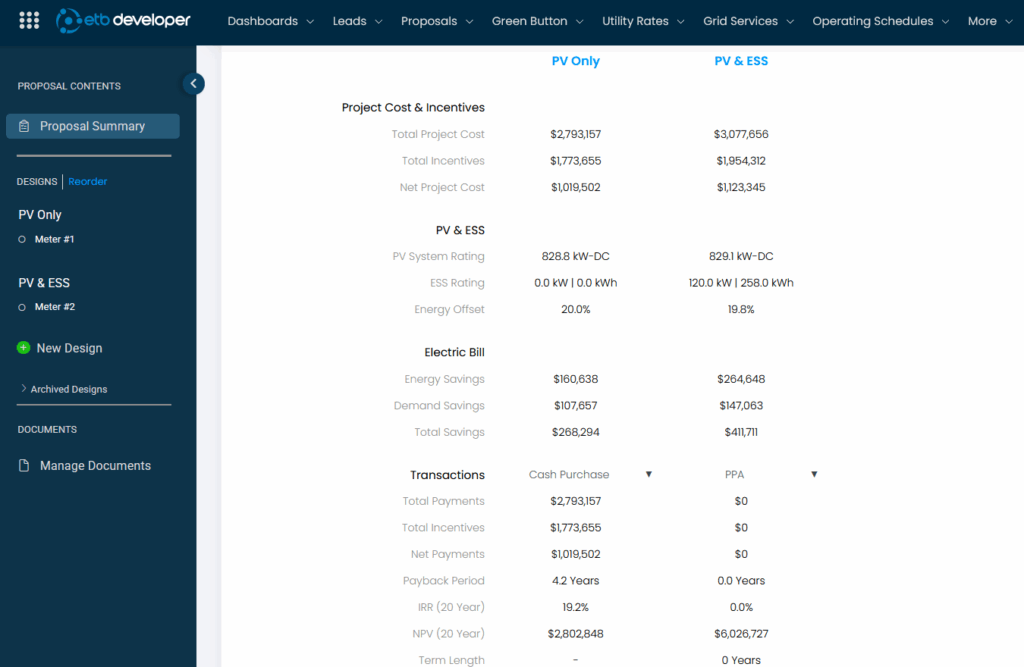
These features give ETB Developer users unparalleled control over their proposals and the kind of information they want to highlight when presenting to clients.
PJM Capacity Price Spikes and TOU Rate Expansion
One of the more notable rate-related stories this year that will affect electricity rates for years to come was a spike in PJM capacity prices. PJM capacity prices at auctions have been hitting record highs year-over-year, resulting in significant increases in capacity charges and utility bills. A large part of this is due to power shortfalls caused by data centers, resulting in tight supply and demand conditions. As a result, customers across PJM’s territory will continue to experience rate increases of up to 60% over the next several years.
One of the ways we’ve seen utilities respond to these rate increases is by implementing more TOU rate schedules. Many utilities are doing away with rate schedules that charge flat $/kWh rates for energy and are opting for TOU rate schedules instead. TOU rates encourage customers to shift their usage to lower-priced off-peak hours to avoid overwhelming the grid during high-priced peak hours. If a customer’s solar generation coincides with the utility’s peak hours, then their solar generation can be used to offset expensive pricing. TOU rates also give more opportunities for energy arbitrage with an energy storage system.
A potential downside of TOU structures is that they require system optimization around TOU hours. This runs the risk of misalignment if peak pricing occurs later in the afternoon or evening outside of prime solar production hours. The addition of a storage system is one way to account for deficiencies in solar-only systems. However, this adds more complexity to projects, and project complexity is one of the biggest challenges developers face, according to a recent poll we conducted during a webinar. That’s where our ETB Consulting team can help.
Our ETB Consulting team excels in optimizing your projects to maximize your results. Whether you’re a seasoned developer looking to save time by outsourcing a project or a newer developer transitioning into the commercial space, working with our ETB Consulting team saves you time, improves accuracy, and provides valuable resources to enhance and personalize your solar and energy storage proposals. Schedule a call with us today and find out how we can help close your next deal.
What’s Coming in 2026
Right away, we’re anticipating rate updates to California’s IOU utilities. PG&E and SCE show overall rate decreases, while SDG&E is showing a 5.1% increase in delivery rates. Our team will have these updates ready to go once they are approved and put into effect.
In 2026, Hawaii customers can expect an update to base rates for the first time in over five years. We recently posted a blog covering Hawaii rate escalation over the past ten years, and this upcoming rate update is likely to increase Hawaii rates even more.
And lastly, we anticipate continued increases in electricity prices across the country, driven by utility investments and infrastructure upgrades. We’ll continue to capture these updates in our rate database so our users can have access to the most recent rate information available for their project models.
Thank you for relying on us for your solar and energy storage modeling needs, and we look forward to helping you close more successful projects in the new year.