 Download Free (.pdf)

IMPORTANT MONTHLY UPDATES & ANNOUNCEMENTS
This month we’re addressing the trend of rising electricity rates, as well as a new business customer class and super off-peak periods for San Diego Gas & Electric (SDG&E), California IOU rate updates, and our quarterly numbers.
Electricity Rates Continue to Outpace Inflation
The new year brought with it many new utility rate updates, and there’s one thing that many of them have in common: Average retail electricity prices continue to trend upwards across the country.
Data published by the U.S. Energy Information Administration (EIA) shows that average retail electricity prices are widely expected to continue rising faster than general inflation through at least 2026, and the primary reasons have less to do with fuel prices and more to do with the structure of today’s utility costs. Across the U.S., utilities are undergoing multi‑year spending cycles focused on grid modernization, storm hardening, wildfire mitigation, and accommodating load growth from data centers, manufacturing, electrification, and population movement. These investments are capitalized in base-rate updates and recovered over several years, creating consistent upward pressure on customer rates.
Even as inflation lets up across the broader economy, regulated utilities are still recovering costs incurred during recent years of elevated prices through rate cases approved today. Fuel costs fluctuate, but delivery and infrastructure charges continue to climb.
For commercial and industrial customers, this means electricity bills are increasingly driven by fixed delivery and peak demand charges, limiting the ability of solar and efficiency-efforts to fully offset rising rates. By contrast, energy storage directly targets the fastest‑growing parts of C&I customer bills, and in some markets, this turns storage from a resilience upgrade into a cost‑control asset with reliable payback.
For C&I customers, storage can reduce exposure to:
Peak demand charges by shaving or flattening load during high‑cost intervals
- Time‑of‑use premiums by shifting consumption away from peak pricing windows
- Rate volatility tied to fuel adjustment clauses and wholesale market swings
Customers with energy storage systems can also enroll in demand response (DR) programs to reduce the impact of demand charges and unlock new revenue opportunities. We support multiple DR programs in regions across the country like the Northeast and California where demand-based charges are highest. Enrollment requirements vary by program, but Energy Toolbase provides the guidance and tools you need to model and prepare your project for successful participation.
SDG&E’s New Business Customer Class and Super Off-Peak Extension
In addition to increasing their electricity rates in January, SDG&E proposed a new business customer rate class and extended super off-peak (SOP) hours for residential customers come April. Currently, SDG&E has two primary commercial rate classes: Small Commercial and Medium/Large Commercial. Beginning in April, the creation of a new Medium Commercial customer class will go into effect, resulting in small, medium, and large commercial rate plans. Customer class will be based on the customer’s demand:
Small Commercial: Demand less than 20 kW
Medium Commercial: Demand between 20 kW and 200 kW
Large Commercial & Industrial: Demand of 200 kW or greater
This change will impact several rate schedules. Rate schedules TOU-M, OL-TOU, and EV-HP will be recategorized as Medium Commercial, and rate schedules AL-TOU and DG-R will be split into Medium and Large C&I versions (e.g., AL-TOU-M and AL-TOU-L).
The addition of another rate class could present opportunities for potential rate switches if a customer can reduce their load within range of a different rate class. Having an energy storage system as well as an intelligent energy management system like ETB Controller can help reduce demand and allow for favorable rate switches. ETB Controller enables multiple strategies for your ESS like:
Manual Dispatch
Demand Charge Management
PV Self-Consumption
TOU Arbitrage
DC Clipping Recapture
Demand Response
And with Acumen AI™, ETB Controller is continuously adapting to changes in site load, rate schedules, and value opportunities without user input to generate the optimum plan for your ESS.
For residential customers, SOP will extend to year-round instead of March and April only. Prior to this update, SOP hours were from 10 a.m. to 2 p.m. on March and April weekdays only, but the March-April limitation will be removed after this update. This larger SOP window provides more opportunities for load-shifting from higher cost Off-Peak hours into lower-cost SOP hours and provides more consistent TOU windows.
You can model all these changes in ETB Developer once they go into effect in April.
California IOU Rate Updates
Pacific Gas & Electric, Southern California Edison, and SDG&E all updated this past quarter. In total, our Utility Rates Team updated 367 California rate schedules in ETB Developer this quarter. Here are the quick facts about the impact of these updates for each IOU:
PG&E:
PG&E updated twice in the last quarter—in January and again in March.
The January update resulted in a 6.2% increase to the system average bundled rates (SAR) and a 23.2% increase to Direct Access (DA) and Community Choice Aggregation (CCA) customers.
The March update resulted in a 2.4% decrease to the SAR and a 1.3% decrease to DA and CCA customers.
Overall, PG&E’s SAR increased by 3.8% and the DA/CCA rates increased by 21.9% this quarter.
SCE:
SCE’s proposed changes resulted in a 6.7% decrease to the SAR, which is approximately a 2.0 cents/kWh decrease for most rate classes.
SDG&E:
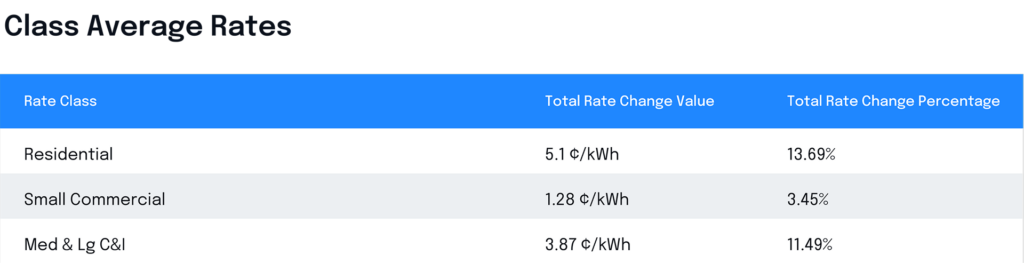
SDG&E’s total SAR increased by 8.1% or 3.0 cents/kWh.
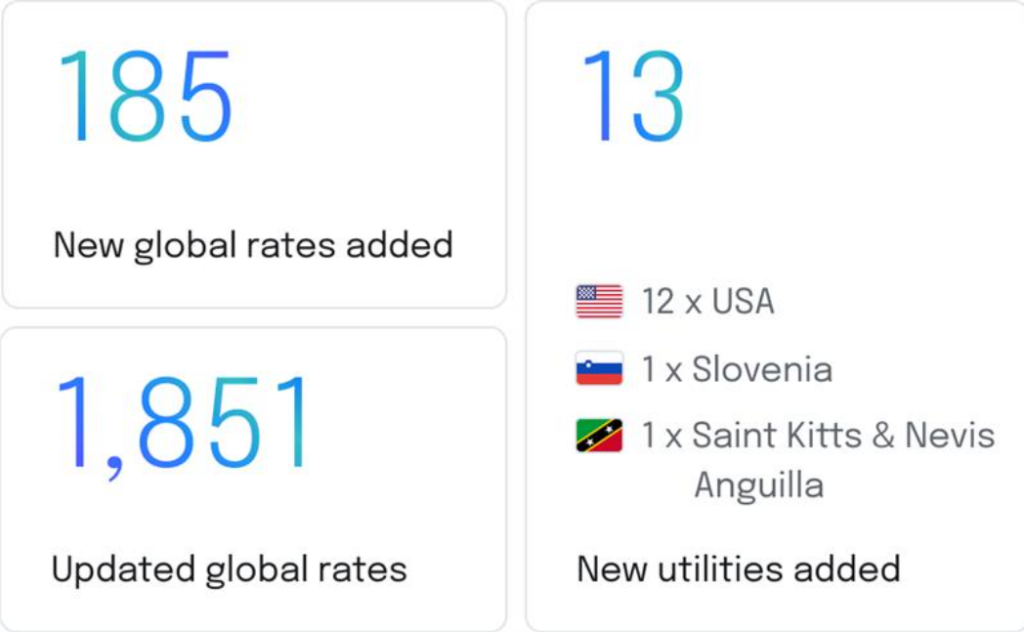
1st Quarter Numbers:
Our utility rates team enjoys sharing our progress with ETB users because much of it comes from user requests. Every utility and rate we add signifies expanding opportunities for solar and storage, and we think that is pretty neat! We quantify our Q1 successes below: