

 Download Free (.pdf)

When modeling solar and energy storage, there are an enormous number of factors to consider, ranging from load profiles and rate schedules to system sizing and controls. Naturally, without experience or general know-how, it can be easy to make simple mistakes that result in costly losses or poor performance, especially as a new developer to the commercial space. Even experienced developers can overlook certain aspects of the design and modeling stages. The innate complexity of each solar and energy storage project and the demand to deliver can make it difficult for teams to produce accurate proposals, especially when time and resources are limited. That’s where our ETB Consulting team comes in.
Recently, our ETB Consulting team hosted a webinar covering common mistakes when considering or modeling solar and energy storage. A poll we conducted in that webinar showed that a major challenge that developers face when it comes to solar and energy storage projects is their complexity:

Figure 1: Project complexity is the number one challenge many developers face with their solar and energy storage projects.
Our ETB Consulting team has worked on projects in nearly every state and has helped developers model projects for a total installation capacity of 2.3 MW of PV and 9.5 MWh of energy storage systems resulting in $1.09 billion and $161 million in total PV and ESS savings respectively. Based on their experience and expertise, here are some of the most common mistakes developers make when modeling their solar and energy storage projects.
1. Incomplete Energy Usage Data
A fundamental problem we often see when it comes to designing and modeling projects is developers working with incomplete energy usage data. Sometimes, developers rely on outdated historical data or general estimates to save time when putting together a proposal. These quick fixes can produce quick results; however, the inaccuracy of these results will have many negative downstream effects on nearly every aspect of a project.
Working with insufficient energy usage often leads some developers to assume the same consumption data and patterns for every month. This assumption fails to account for seasonal differences and operational changes that produce variance in a site’s load. Using energy data that is inconsistent with the site’s actual consumption can lead to improper system sizing and ultimately skew the projected financials.
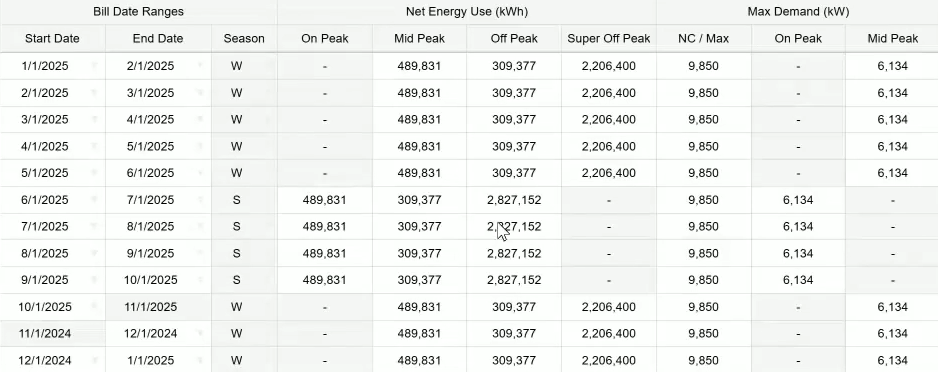
Figure 2: Inputting the same data for a whole year fails to capture the site’s actual load and will result in incorrect system sizing.
How to avoid this mistake: It’s best to gather all relevant energy usage data including 12 months of bills, interval data, and any supplier bills if you’re working in a deregulated energy market. With this information in hand, you can make reliable models that lead to accurate system sizing and economic estimates.
Our ETB Developer platform makes it easy to work with or retrieve this data by giving users several options for uploading energy data including manually inputting bill data, uploading interval data, or using Green Button Data and Utility API options that can fetch the customer’s energy usage directly from the utility.
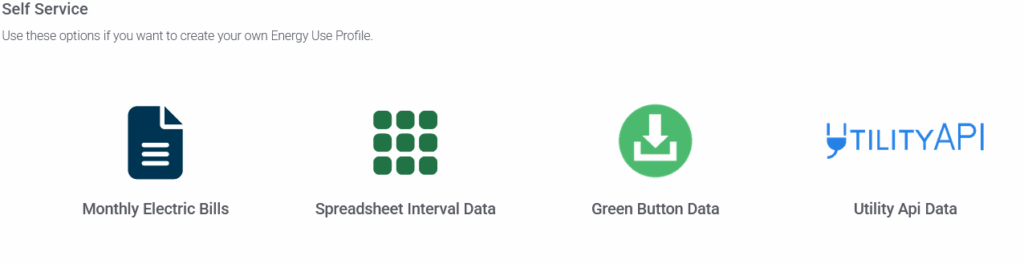
Figure 3: ETB Developer features make it easy to work with the most recent and accurate energy data.
2. Proxy Load Profiles
Another common mistake is using a placeholder load profile that doesn’t match the actual site. The load profile tells you how the customer uses their energy, and every building type and facility has its own energy patterns. Some sites are more favorable for solar because their usage coincides with peak solar production hours, while consumption for other sites may occur outside of these favorable windows. A mismatched or generic load profile can lead to misshapen load curves and unrealistic expectations for energy production and savings.
How to avoid this mistake: Make sure the load profile you work with closely matches your site’s hourly operations. For example, a warehouse and a hotel are likely to have very different usage patterns and demand spikes throughout the day. Using an unrelated load profile for a site might make the project look better on paper, but the actual results will look much different. That’s why it’s crucial that your load profile is as similar to the actual site as possible.
ETB Developer makes this easy for users by enabling them to upload and create their own load profiles or choose from over 16 default load profiles with data backed by the National Renewable Energy Laboratory.
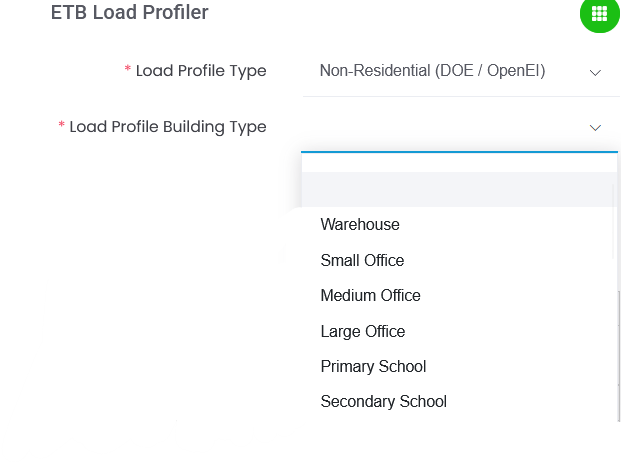
Figure 4: Default load profile options in ETB Developer are backed by data from the Department of Energy.
You’ll also want to consider the addition of any facility expansions or energy efficiency upgrades and the impact these changes will have on the future load profile. Modeling the site’s real-world conditions will give more accurate results and provide clear and actionable opportunities for additional technologies like energy storage.
3. No Utility Rate Customization
Another crucial mistake is not customizing a rate schedule to match a customer’s rate as closely as possible. It’s easy for development teams to simply approximate a customer’s utility rate instead of verifying the exact details of the rate schedule like the time-of-use windows, demand charges, demand ratchets, rate switches and more. These additional details can add an extra layer of complexity to an analysis that some teams would rather avoid; however, failing to account for these details can lead to incorrect savings projections and potentially undermine the viability of a project.
How to avoid this mistake: The best way to account for every rate schedule detail is to reference the most recent tariff sheets from the utility in conjunction with the most recent bills. These sheets should provide the rates for energy and demand charges, the applicability of any riders and adjustments, and the presence of any demand ratchets, and testing the rate against recent bills is a great way to verify your accuracy.
Another factor to consider when analyzing rate schedules is the possibility of a rate switch. Utility rate tariffs often have availability sections that provide details on which customers are eligible to enroll on that schedule. Some schedules have caps and cutoffs on the number of customers that can enroll. A detailed solar and energy storage project will consider the possibility of a rate switch post-solar or energy storage for a customer who can reduce their usage enough to make the switch. Consider the potential savings a rate switch can achieve for this example of a customer switching from schedule TOU-8-D to TOU-8-E:
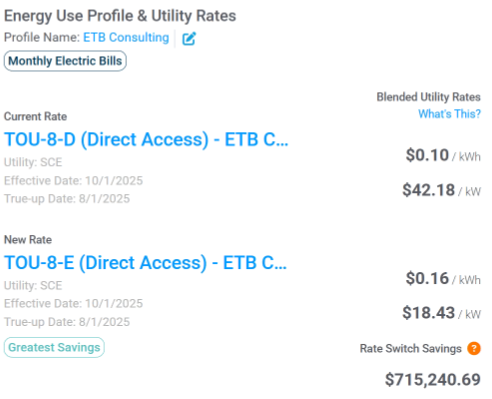
Figure 5: This particular project can see over $700,000 in savings by simply switching rate schedules to a more solar and energy storage-friendly option.
A development team that opts for a surface-level rate analysis is potentially leaving tens or hundreds of thousands of dollars of savings on the table. That’s why outsourcing a project or leveraging outside expertise like that provided by our ETB Consulting team is an invaluable resource since they are also experts at understanding the nuances of rate schedules.
4. Misaligned Net Metering
The last common mistake has to do with misaligned or misinterpreted net metering rules. These rules determine limitations on system size and how excess energy from your renewable systems is credited. Mistakes in this phase can result in overestimated financial savings, incorrect system sizing, and missed opportunities for strategies like demand charge management.
How to avoid this mistake: Thoroughly interpreting a utility’s net metering rules is key to avoiding any of these errors. Factoring in caps on system size and the type of compensation for excess energy into your project model will ensure reasonable cash flow projections and financial savings. For these reasons, optimizing the system is far more valuable than maximizing the system.
Our ETB Consulting team excels in optimizing your project models in order to maximize your results, and our ETB Developer platform has many different features to help like our pre-configured NEM Programs for your selected utility and our ETB Optimizer that lets you quickly run advanced simulations to determine optimal system size for both PV and ESS.

Figure 6: The ETB Optimizer allows you to compare rate switches to size your system and model savings and expected energy generation.
These mistakes when modeling solar and energy storage are easy to make and range from basic oversights to limitations in knowledge. Avoiding them will take your projects to the next level and make your proposals stand out. Working with our ETB Consulting team saves you time, improves accuracy, and provides valuable resources to enhance and personalize your solar and energy storage proposals. Schedule a call with our ETB Consulting team today and let us be your end-to-end partner in developing solar and energy storage solutions that you can be confident in closing!